The Wright Venue: 5 Frank Lloyd Wright-Designed Venues for Your Next Meeting
Iconic architect Frank Lloyd Wright designed spaces that are ideal for one-of-a-kind, ambiance-filled events.
 by
by 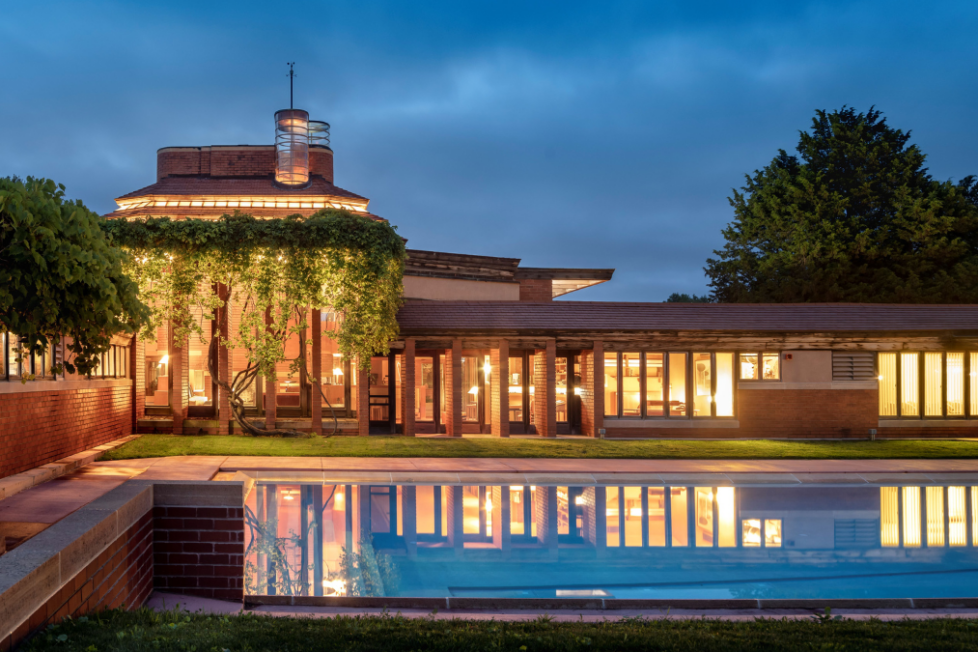

Iconic architect Frank Lloyd Wright designed spaces that are ideal for one-of-a-kind, ambiance-filled events.
by By Shelby Deering | Photo: ©Wingspread Retreat & Executive Conference Center
Architect Frank Lloyd Wright is as much a part of the Midwest as farming and a Friday fish fry. He was born in Richland Center, Wisconsin, and became the preeminent architect of the 20th century, designing well-known residences and structures like Pennsylvania’s Fallingwater and New York’s Guggenheim Museum. He lived most of his life in Spring Green, Wisconsin, and here in the Midwest, we’re lucky to say that the region boasts the highest concentration of Frank Lloyd Wright-designed buildings in the world.
Many of these buildings are open to the public, and can even be booked for meetings or events. If you want to do away with indiscriminate conference centers and stuffy hotels, and embrace a Frank Lloyd Wright property for your next meeting instead, read on.
The Monona Terrace Community and Convention Center is one of Frank Lloyd Wright’s most famous works.
Lying along the shores of Lake Monona, Wright first proposed the design of Monona Terrace in 1938 and, although the project was once abandoned by a bill that reduced its height, it was revived once again in 1990 and became the geometric wonder it is today.
“When event planners and attendees first visit our space, they are immediately captured by the architecture. There’s the ‘wow’ factor of our sweeping views of Lake Monona, the iconic rooftop and the grand interior spaces, but also a deeper experience to be had that’s rooted in good design,” according to Kristen Durst, the community and public relations manager of the Monona Terrace Community and Convention Center.
With five levels, 30 rooms and spaces ranging from 350 to more than 37,000 square feet, there’s no shortage of space. You can book the Grand Terrace for windows that showcase sweeping lake views or the Rooftop Gardens Center Circle for an outdoor experience. Attendees can enjoy the group Architecture Tour, or tempt their palates with the Wine & Cheese or Bubbly tours. The venue fully provides all audiovisual services and there’s a 600-space parking structure as well.
“Wright first designed the Monona Terrace to be a civic center, many years before the facility was built,” Durst explains. “He always envisioned Monona Terrace as a place for people to gather and connect, and was deeply focused on how people move through and experience space. His philosophies on architecture are closely aligned with the goals of modern meetings and events, where fl ow, interaction and shared ideas are essential.”
Wright laid down roots at his home, Taliesin, which was first built in 1911, but then endured fires that caused him to add construction and renovations, in Spring Green.
Sitting on a stunning 800 acres of green hills and valleys, the estate is made up of several buildings where Wright “lived, worked, and experimented with principles of organic architecture and design for nearly 50 years,” as Sally Monroe-Tockes, the Taliesin events coordinator, puts it.
She goes on to say, “Frank Lloyd Wright’s architectural vision is so singular and individual that his buildings lend themselves quite easily to the making of a memorable experience. I think, to a lot of event planners, that’s super important — you want your attendees to say, ‘Hey, remember when we had our retreat at Taliesin?’ and not, ‘I can’t even think of what we did last year.’”
There’s a wide array of meeting spaces to choose from, like the 1,400-square-foot Frank Lloyd Wright Visitor Center that can accommodate 125, the 1,800-square- foot Hillside Theater that can hold up to 100 attendees and the Taliesin home itself at 5,500 square feet with the ability to facilitate 50 guests. No matter what space you choose, Frank Lloyd Wright’s brand of modernism and nature-inspired details are alive and well.
Catering is available, along with beverage packages, and attendees can park at the Frank Lloyd Wright Visitor Center, just across the road from the Taliesin estate, where they can then take a shuttle ride to their destination.
And, of course, tours can be a top activity during your event.
“Group tours are a great way to enhance a private event at Taliesin, especially since they frequently allow guests the chance to explore spaces beyond the one they’ve rented,” Monroe-Tockes says.
“We can be quite flexible with the timing of these tours and like to find clever ways to work them into a larger itinerary — for example, a group might rent Hillside Theater for a symposium, followed by a tour of the house that ends in a cocktail hour on Wright’s bedroom terrace.”
Near Lake Michigan lies a private home that Wright designed for the SC Johnson family in 1939. They lived there through the 1960s, and eventually donated it to the Johnson Foundation, which has since used Wingspread as a meeting and event destination.
“Frank Lloyd Wright was known for incorporating natural surroundings into his architecture. In our case, the prairie,” according to Heather Roose, the director of sales at Wingspread Retreat & Executive Conference Center in Wind Point.
“It allows our guests to sit outside, and enjoy nature, the trails and the quiet that comes with 36 acres,” she shares.
Your attendees will feel as if Wright has come to life through a 45- to 60-minute docent-led architectural tour of the home. Roose adds, “Some of our groups use this as an opportunity for a cocktail reception or networking.”
She says that the venue can also incorporate a dinner and evening hospitality in Wingspread while your group is on campus.
For the maximum capacity of 55 individuals, you can book the Prairie Room, Wind Point Room, Fire Pit Patio, Dining Room or Cypress Terrace, or turn to other spaces, like the Blue Heron Room or the Theatre, that are ideal for small gatherings. There are also 40 guest rooms so your attendees can make a trip of it.
The property has complimentary self-parking and electric vehicle charging, and amenities abound, which can be experienced through an all-inclusive meeting package that includes accommodations, a full breakfast, lunch and dinner services, break services, a meeting room that suits your needs and audiovisual equipment.
Roose adds that planners receive “a dedicated conference planning team member to help with all the details, the rooming list, audiovisual needs, agenda creation, menus, transportation etc.”
Head to the Frank Lloyd Wright-designed Laurent House for your next meeting or event. As a private home commissioned by Kenneth and Phyllis Laurent in 1948, today, it’s the only home designed by Wright that’s wheelchair accessible, due to the fact that Kenneth was a paraplegic after injuring his spinal cord in World War II.
Flanked by beautiful trees, the home exudes a feeling of warmth and comfort, punctuated by Wright’s trademark touches. Mary Beth Peterson, the executive director, says the Laurent House “offers something special to the attendees and is a space that will be long remembered.” During meetings, tours are a must. Peterson says that the tours last approximately one hour and consist of groups of up to eight people.
Laurent House is ideal for smaller gatherings, with meetings taking place in the property’s 1927-built Visitor Center, which lies across the street from the house and can hold up to 24 people. There’s parking available for 23 cars and Laurent House can work with you for any of your catering needs. The Visitor Center has Wi-Fi and a flatscreen monitor for presentations.
Chicago and its suburbs have the largest collection of Frank Lloyd Wright- designed structures in the Midwest — in fact, the area boasts the most Frank Lloyd Wright buildings in the world. This is where you’ll find The Rookery, a commercial building that houses offices and retail establishments. The building was designed by Daniel Burnham and John Wellborn Root, and completed in 1888, and the interior work was designed by Frank Lloyd Wright in 1905.
“Its iconic light court, ornamental ironwork and historic charm make it a centerpiece of Chicago architecture,” says Greg Jenkins, president of Jewell Events Catering, the exclusive catering and special event partner of The Rookery. “For planners, we describe it as a place where history and innovation meet, perfect for events that need both elegance and character.”
The Wright-designed light court reception area, which features a striking Oriel Staircase, can accommodate up to 200 guests for standing receptions, which Jenkins says is ideal for cocktails and networking. Jewell Events Catering provides catering in addition to full event coordination, audiovisual support, drapery services and equipment setup.
And since The Rookery partners with the Frank Lloyd Wright Foundation, it offers guided tours that focus on Wright’s contributions to the design and overall history of the building.
“Event groups can coordinate tour times before, during or after their events to enhance the experience for attendees,” according to Jenkins, who adds that, beyond tours, the property offers curated experiences that combine architecture, history and hospitality, which are perfect for corporate team-building and educational groups.
Paid parking is available nearby, and the venue provides guidance on the closest parking facilities and public transit options to support attendees.
“The Rookery combines historic significance with modern event flexibility. Every event benefits from our dedicated team, carefully curated amenities and a venue that transforms ordinary gatherings into memorable experiences,” Jenkins says.
